
At some point after 40, it felt like my metabolism just… disappeared.
I wasn’t eating more. I wasn’t sitting around all day. I was still trying to “do the right things,” but my body felt heavier, slower, and harder to manage than it ever had before.
And no one really talks about that moment — the one where you realize your body isn’t responding the way it used to, and you start quietly wondering if this is just how it is now.
Why I Thought I Was the Problem
When that starts happening, it’s hard not to assume you’re the problem.
I kept wondering what I was missing or messing up. I thought maybe I wasn’t being consistent enough, or that I needed to tighten things up even more.
But the harder I tried to control everything, the more stuck I felt — like my body was no longer playing by the same rules.
Realizing I Wasn’t Failing
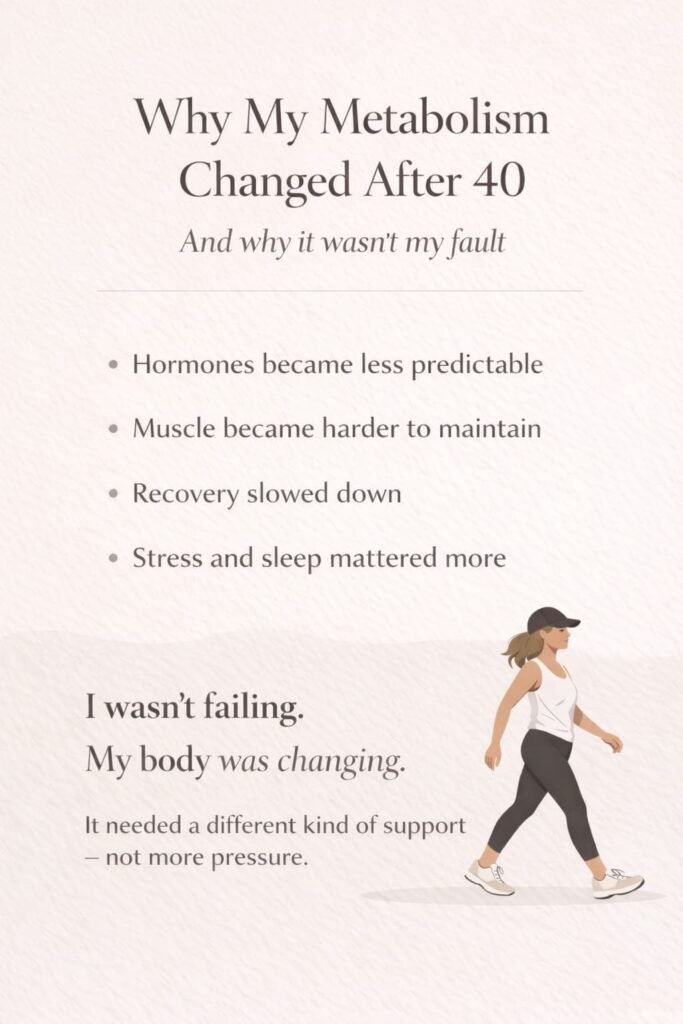
What took me a long time to understand is that I wasn’t failing — my body was changing.
Not in a dramatic, overnight way, but in quieter, more gradual ways that are easy to miss until nothing works like it used to.
Once I stopped treating my body like a problem to solve and started seeing it as a system that needed different support, things finally began to make sense.
What Actually Changes After 40
After 40, a lot of small things start shifting in the background.
Hormones become less predictable, muscle becomes harder to hold onto, and recovery isn’t what it used to be.
Stress and sleep seem to matter more than they used to, and movement doesn’t happen as naturally throughout the day.
None of these changes feel dramatic on their own — but combined, they can completely change how your body responds.
Why the Old Playbook Stopped Working
For a long time, I kept reaching for the same strategies that had worked for me years earlier.
More intense workouts.
Fewer calories.
Trying to push through when progress slowed.
But as my body changed, that approach began to work against me.
Instead of helping my metabolism, it added more stress — and I ended up feeling tired, stuck, and frustrated more often than not.
The Shift That Changed Everything
The real shift came when I stopped trying to force results and started listening to my body instead.
Rather than adding more pressure, I began choosing habits that felt sustainable instead of exhausting.
That mindset change alone made everything feel more manageable — even before anything visibly changed.
Moving Forward With a Different Kind of Strategy
Understanding what was happening to my metabolism didn’t magically fix everything.
But it changed how I approached my body.
Once I stopped blaming myself and trying to do more, I could finally see where things had been getting unnecessarily complicated.
And that mattered — because even something as simple as walking didn’t start working for me until I simplified everything else first.
Understanding this was the first step for me. The next was simplifying everything I was doing — because even walking didn’t start working until I did.